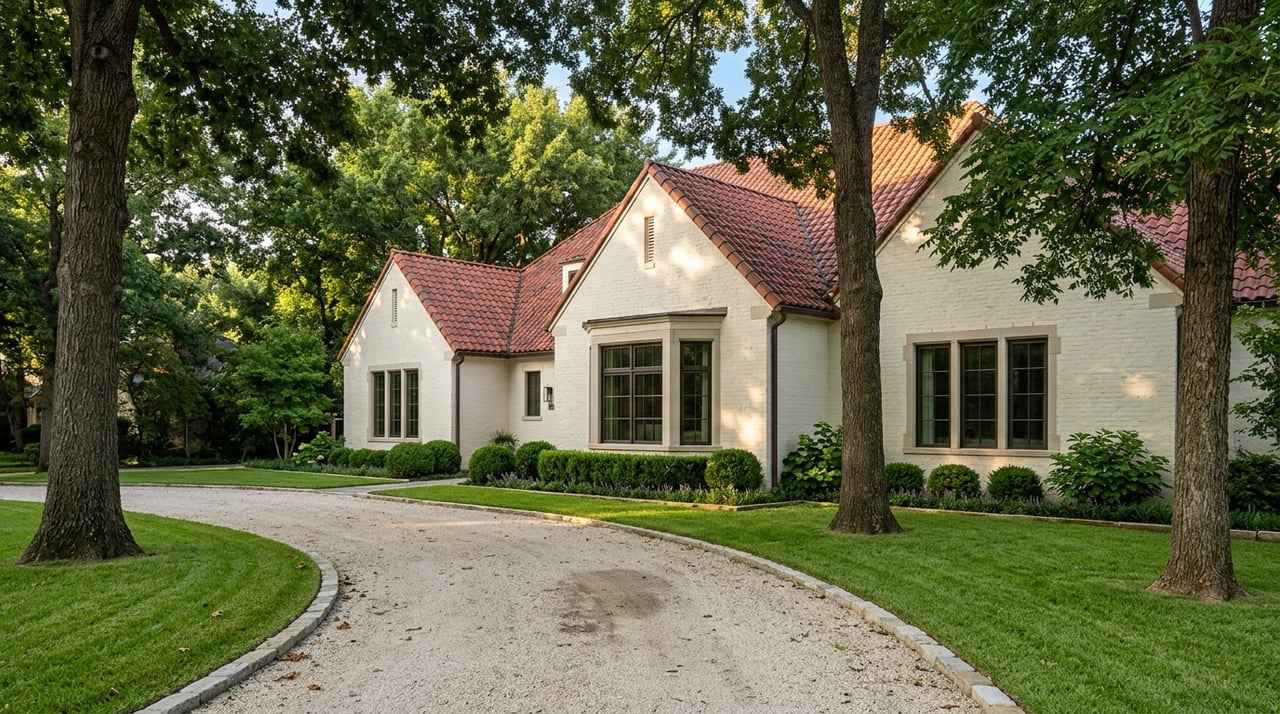
Trying to choose between Westover Hills and Rivercrest? If you are looking at Fort Worth’s estate market, this is one of the most important decisions you can make because these two areas may sit close to each other, but they live very differently. One offers a more private-town feel with tightly managed residential standards, while the other centers more around historic streets and club-oriented living. This guide will help you compare the two so you can decide which setting fits your priorities best. Let’s dive in.
Westover Hills at a glance
Westover Hills is not just a neighborhood. It is a small incorporated town that, according to the town, was established as a Class A city in 1939 and today includes about 277 homes and roughly 700 residents. The town also maintains its own police department, which adds to its self-contained residential feel.
For estate buyers, that distinction matters. Westover Hills is shaped by municipal governance, zoning, and review standards that support low density and a carefully preserved built environment. The town states that its rules are intended to protect spacious lots, large trees, and conservative architecture, with only one private single-family residence allowed per lot according to its code and review framework.
Rivercrest at a glance
Rivercrest has a different identity. Its story is closely tied to River Crest Country Club, which opened in 1911 and was the first Fort Worth country club to include a residential development on its acreage.
That history still shows up in the streetscape today. The Tarrant County historic survey describes River Crest East as a more uniform, architect-designed area with mostly Classical and Colonial Revival homes and some Tudor Revival influences, while River Crest West includes larger parcels on the bluffs. In practical terms, Rivercrest feels more layered and varied than Westover Hills.
How the setting feels
Westover Hills feels more controlled
If you want consistency, Westover Hills usually stands out. The town’s development standards and variance review process support a setting where lot pattern, tree canopy, and architectural tone stay relatively cohesive over time. That can appeal to buyers who care deeply about privacy, preservation, and a more insulated estate environment.
Because of that structure, Westover Hills often feels less like a traditional neighborhood and more like a legacy residential enclave. You are buying into a town with a very defined point of view about how the community should look and function.
Rivercrest feels more historic and social
Rivercrest tends to offer a broader mix of experiences. Some streets feel closely tied to the club and its history, while other areas, especially on larger bluff-side parcels, feel more estate-like and distinct.
If you enjoy a neighborhood with visible layers of architectural history, Rivercrest may feel more compelling. Rather than one highly controlled expression, it reads more like a storied district with different pockets and personalities.
Lot sizes and privacy
Westover Hills lot patterns
Westover Hills currently reads as the more uniformly estate-sized option. Recent listing examples cited in the research include lots of approximately 0.39, 0.5, 0.53, 0.68, and 1.21 acres. That points to a fairly consistent luxury-lot profile, especially considering how close the town is to Fort Worth’s urban core.
That consistency can be valuable if you want a setting where neighboring homes are more likely to share a similar scale and spacing. For many buyers, that creates a stronger sense of privacy and predictability.
Rivercrest lot patterns
Rivercrest is still very much an estate market, but the lot mix is wider. Current or recent examples in the research include 6,534-square-foot lots along with parcels of about 0.34, 0.43, 0.48, and 0.95 acres.
In other words, Rivercrest gives you more variation. Depending on the street and whether a home has been updated or rebuilt, you may find a very different experience from one property to the next.
Architecture and character
Westover Hills architecture
Westover Hills leans toward a more curated architectural environment. The town says its standards are designed to preserve conservative architecture, spacious lots, and mature trees, and historic examples documented in the area include Tudor Revival, Colonial Georgian Revival, Mediterranean-Spanish Colonial Revival, and Chateauesque influences.
For buyers who want architectural quality within a tightly managed framework, that can be a major advantage. The consistency of the overall environment is part of the value proposition.
Rivercrest architecture
Rivercrest offers strong architectural pedigree too, but with more visible range. According to the county historic survey, River Crest East is known for architect-designed homes with uniform setbacks and mostly Classical or Colonial Revival styles, along with some Tudor Revival homes. River Crest West is associated with larger parcels on the bluffs overlooking the river.
That creates a different kind of appeal. If you like the idea of a historic neighborhood where each street may tell a slightly different story, Rivercrest may be the better match.
Market conditions and inventory
Westover Hills pricing
As of March 31, 2026, Zillow’s Westover Hills home value estimate was $2,662,449, up 8.1% year over year. Realtor’s market overview cited in the research showed only four active listings in December 2025, while current listings ranged from about $1.95 million to $5.495 million.
That snapshot reinforces two things. First, Westover Hills is a high-value estate market. Second, inventory is extremely limited, which means timing and access matter.
Rivercrest pricing
Rivercrest is even thinner as a market. Realtor’s Rivercrest market page notes one home for sale and zero rentals, and the neighborhood does not yet have stable neighborhood-level price metrics of its own.
The research also notes a December 2024 sale snapshot showing a median sale price of $2.4 million, about $474 per square foot, and 9.4 days on market. Because the sample size is so small, Rivercrest numbers can swing sharply from one period to the next.
What buyers should take from that
Both areas are thin markets where one listing or one sale can influence the data. Westover Hills currently appears to be the higher-value market based on Zillow’s estimate and the top end of active listings, while Rivercrest data looks more volatile because there are so few transactions.
If you are shopping in either area, broad averages only tell part of the story. Property-specific analysis matters far more than it would in a larger neighborhood with steady turnover.
Daily-life fit
School information to verify
If schools are part of your search, it is important to confirm them by exact address. For Westover Hills, Realtor’s overview surfaces M L Phillips Elementary among nearby schools, while Fort Worth ISD’s Arlington Heights pyramid lists nearby options such as Burton Hill, North Hi Mount, Ridglea Hills, South Hi Mount, and Arlington Heights High School.
FWISD also provides a school-finder tool for address-specific confirmation. In Rivercrest, Realtor identifies North Hi Mount Elementary, Stripling Middle School, and Arlington Heights High School as the public-school path for the neighborhood.
Club access and social rhythm
One of the clearest differences between these two areas is how central club life feels. Rivercrest is closely connected to River Crest Country Club, and the club’s own history describes it as more than a golf club, emphasizing its role as a social hub where families gather.
Westover Hills, by contrast, is near Shady Oaks Country Club, according to the research, but it does not revolve around a club-centered neighborhood identity in the same way. If you want club access nearby without having the neighborhood story centered on that experience, Westover Hills may feel more natural.
Which market fits you best?
Choose Westover Hills if you want:
- A more private-town feel
- Lower density and larger, more consistent estate lots
- Strong municipal oversight and preservation standards
- A highly curated residential environment
- A setting that feels more insulated and legacy-oriented
Westover Hills is often the stronger fit for buyers who want structure, privacy, and long-term neighborhood continuity. If your ideal estate setting is quiet, controlled, and consistently scaled, this market usually aligns well.
Choose Rivercrest if you want:
- A stronger connection to club-centered living
- A neighborhood with deeper historic layering
- More variety in lot sizes and home styles
- Streets with distinct personalities and architectural moods
- A setting that feels social, storied, and visually varied
Rivercrest is often the stronger fit for buyers who are drawn to historic character and a neighborhood identity shaped by both architecture and club tradition. If you want more variety and a more layered streetscape, Rivercrest may be the better match.
The bottom line
If you want the simplest shorthand, Westover Hills is usually the better fit if you prefer a more controlled private-town estate environment. Rivercrest is usually the better fit if you want stronger club identity, more visible historic texture, and a neighborhood with multiple sub-moods.
The right choice depends on how you want your home to feel day to day. If you are weighing privacy, lot consistency, architecture, or off-market opportunities in either area, the best next step is a property-level conversation with a team that knows both markets closely. To request a private consultation with our Fort Worth luxury specialists, connect with the Duwe-Olsen Group.
FAQs
What is the main difference between Westover Hills and Rivercrest for Fort Worth estate buyers?
- Westover Hills generally offers a more controlled, private-town feel with consistent estate lots, while Rivercrest offers a more historic, club-centered setting with greater variation in homes and streetscapes.
Which area has larger lots, Westover Hills or Rivercrest?
- Based on the research, Westover Hills tends to have more uniformly estate-sized lots, while Rivercrest has a wider range of parcel sizes depending on the street and property.
Is Westover Hills a neighborhood or its own town?
- Westover Hills is its own incorporated town, and that is part of why it feels more self-contained and more tightly managed than a typical neighborhood.
Is Rivercrest centered around River Crest Country Club?
- Yes. Rivercrest’s identity is closely tied to River Crest Country Club, which has been part of the area’s history since 1911.
Are home prices higher in Westover Hills or Rivercrest?
- The research indicates Westover Hills currently appears to be the higher-value market based on Zillow’s average home value estimate and current listing ranges, while Rivercrest data is more volatile because sales volume is very limited.
How can you verify school assignments in Westover Hills or Rivercrest?
- You should verify school assignments by exact address using Fort Worth ISD’s school-finder tool and current district resources, since nearby school information can vary by property.
